Your business is finally making money.
Then someone tells you:
“You should elect S corp. You’ll save thousands in taxes.”
Maybe.
But before changing how your business is taxed, there’s a more useful question:
Where, exactly, are those savings supposed to come from?
The usual explanation sounds simple.
As a sole proprietor, your business profit is generally exposed to self-employment tax.
With an S corporation, you pay yourself reasonable wages for your services, while remaining business profit may pass through to you without being treated as self-employment income. Cash distributions are a separate step.
So the story becomes:
Salary gets payroll tax. The rest doesn’t. Tax savings.
Except that isn’t the whole calculation.
Your salary has to be reasonable for the work you perform. Wages can change the qualified business income deduction. Income from another job can change the Social Security calculation. Salary can affect retirement-plan contributions. The S corporation creates payroll, filing, and administrative costs.
And if you’re doing business in New York City, the city introduces another tax system into the comparison.
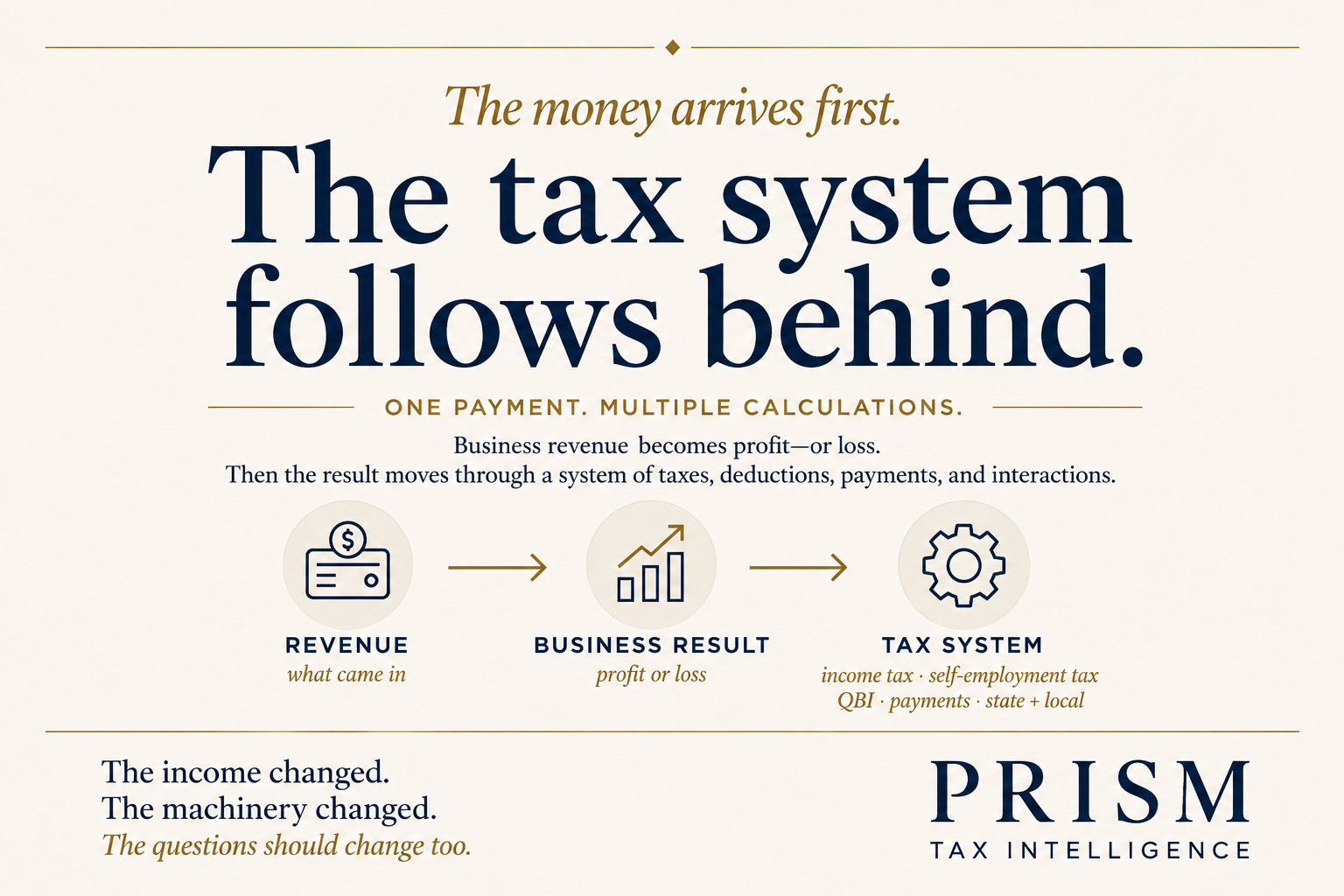
An S election doesn’t make tax disappear.
It changes how business earnings move through the tax system.
The real question is whether the advantage that survives all of those changes is worth the additional structure.
First: your LLC and your S corp are not the same thing
This is where a lot of the confusion begins.
People often ask:
“I have an LLC. Should I switch to an S corp?”
But an LLC and an S corporation usually aren’t two competing versions of the same thing.
An LLC is a legal entity created under state law. Its federal tax classification is a separate question.
A single-member LLC, for example, is generally disregarded for federal income-tax purposes unless it elects another classification. Its business activity may therefore appear on the owner’s Schedule C.
An eligible LLC can elect to be taxed as an S corporation without necessarily giving up the LLC itself.
So the better question is:
Should the business keep its current federal tax treatment—or elect to be taxed as an S corporation?
That sounds like a technical distinction.
Economically, it matters because the election changes what happens to the money the business earns.
Where the S corp tax advantage actually comes from
Imagine a single-owner business earns $120,000 before paying its owner.
Under a simplified Schedule C structure, the owner is self-employed. Business profit generally feeds into the self-employment-tax calculation.
An S corporation works differently.
If the owner performs more than minor services for the corporation and receives or is entitled to compensation, the owner generally must be treated as a shareholder-employee for those services.
That means reasonable compensation.
Suppose, purely for illustration, reasonable compensation is $70,000.
Now the economics begin to separate.
$70,000 becomes wages.
The corporation pays its share of payroll taxes on those wages.
The owner pays the employee share.
After wages and the employer payroll-tax deduction, the remaining corporate profit can pass through to the shareholder. That residual S-corporation business income generally isn’t self-employment income.
That difference is the source of the familiar S-corp tax strategy.
But notice what happened.
We didn’t eliminate tax on $120,000.
We changed the route the $120,000 takes.
And every part of that route matters.
The first savings number isn’t the answer
Let’s stay with the $120,000 example.
Assume:
- one owner filing single;
- no other wages;
- $120,000 of business profit before owner compensation and employer payroll tax;
- $70,000 of illustrative reasonable compensation;
- taxable income low enough that the §199A wage/property and SSTB phase-in limitations do not apply, and the overall taxable-income limitation does not reduce the modeled QBI deduction;
- no retirement-plan or health-insurance adjustments;
- no state or local taxes;
- no FUTA or state unemployment taxes; and
- a 22% illustrative marginal federal income-tax rate.
This is an educational illustration.
It is not a recommendation that $70,000 is reasonable compensation for a business earning $120,000. Reasonable compensation depends on the actual facts.
On the Schedule C side, the regular self-employment-tax calculation generally begins with 92.35% of relevant self-employment profit.
Under these assumptions:
$120,000 × 92.35% = $110,820
The resulting regular self-employment tax is approximately:
$16,955
Now look at the S corporation.
A $70,000 salary produces approximately:
$10,710
of combined employee and employer Social Security and Medicare tax under the simplified assumptions.
The apparent employment-tax advantage is therefore roughly:
$16,955 − $10,710 = $6,245
That looks compelling.
And this is where a lot of S-corp comparisons stop.
You saved $6,245.
Except we haven’t finished the return.
The payroll-tax savings can change your QBI deduction
The qualified business income deduction complicates the comparison.
Eligible Schedule C business profit can generally contribute to QBI after applicable adjustments.
But reasonable compensation paid to an S-corporation shareholder is not QBI.
That means the same salary that creates the employment-tax structure can simultaneously reduce the amount of business income eligible for the QBI deduction.
In our simplified Schedule C example, the deduction for one-half of regular self-employment tax reduces the amount feeding the modeled QBI calculation.
That leaves approximately:
$111,522 of modeled QBI
and, under the stated assumptions:
$22,304 of modeled QBI deduction.
Now follow the S corporation.
The business started with $120,000.
It paid $70,000 of wages.
It also incurred approximately $5,355 of employer payroll tax.
That leaves roughly:
$44,645 of residual S-corporation business income.
Under the same simplified QBI assumptions, that produces approximately:
$8,929 of modeled QBI deduction.
The employment-tax calculation favored the S corporation.
The QBI calculation moved the other direction.
Once the relevant QBI and self-employment-tax deduction differences are reflected, the S-corporation structure produces roughly $16,498 more taxable income in this simplified example.
At an illustrative 22% marginal federal rate, that’s approximately:
$3,630 of additional income tax.
So:
Did the employment-tax calculation show a $6,245 advantage?
Yes.
Did the S corporation produce $6,245 of overall federal tax savings?
No.
Under this simplified illustration, roughly $3,630 of the employment-tax advantage is offset by the income-tax effect of the changed deductions.
That leaves an estimated federal advantage of about:
$2,615
And we still haven’t included payroll software, tax preparation, unemployment taxes, state and local taxes, or the administrative cost of maintaining the structure.
The $6,245 wasn’t wrong.
It just wasn’t the answer yet.
PRISM Decision Intelligence
The S Corp Refraction
One election. Multiple effects. One decision.
The number people stop at
$6,245
Employment-tax advantage
Most comparisons stop here.
What it refracts into
Employment tax
+$6,245
QBI + income tax
−$3,630
Other W-2 income
Wage-base interaction
Retirement + benefits
Not fully modeled
State + local tax
Not fully modeled
Compliance + administration
Not fully modeled
- Solid — modeled in this illustration
- Dashed — material effect not fully modeled
Current modeled result
- Employment-tax advantage
- +$6,245
- QBI + income-tax effect
- −$3,630
- Additional Medicare effect
- $0
After the first refraction
$2,616*
Modeled federal advantage so far
Not yet an economic-savings result.
Excludes retirement and benefit interactions, unemployment taxes, compliance costs, state/local taxes, AGI/MAGI-sensitive credits and deductions, advanced §199A mechanics, and other unmodeled effects.
This is not a complete S-corp savings calculation.
Retirement, benefits, unemployment taxes, compliance costs, state/local taxes, AGI/MAGI-sensitive credits and deductions, advanced §199A mechanics, and other unmodeled effects may increase or reduce the economic result.
Explore the illustration
Adjust the assumptions used in this article to see how the modeled result changes. This illustration intentionally does not extrapolate beyond the scenarios discussed here.
This illustration is bounded by the example analyzed in the article.
Enter a compensation assumption to test. PRISM does not determine whether this amount is reasonable under IRS standards. Reasonable compensation is facts-and-circumstances based; this interactive applies no threshold, percentage-of-profit, salary-to-distribution ratio, or salary floor, and a positive figure entered here is never treated as reasonable.
What makes compensation reasonable?
The modeled owner’s Social Security wages. Do not include a spouse’s wages here. This control illustrates the employment-tax interaction only. Simplified §199A treatment is held fixed as an article assumption and is not re-run through §199A thresholds, SSTB phase-ins, W-2 wage or UBIA limitations; where these wages move the scenario beyond that assumption, the illustration stops instead of showing a figure.
Fixed article assumptions
- Filing status
- Single — article illustration
- Illustrative federal marginal rate
- 22% — article illustration
About the 22% rate
This illustration stops here
This interactive is intentionally limited to the scenarios analyzed in this article. Larger or different fact patterns can introduce additional tax interactions that are not modeled here.
Assumptions and status
QBI assumptions — simplified article assumptions ✓
The illustration assumes the simplified §199A treatment described in the article. It has not determined your actual QBI eligibility, and the simplified calculation is not used where the facts would require Form 8995-A phase-in, SSTB, W-2 wage, UBIA, or carryforward analysis. As an explicit assumption of this illustration, the §199A taxable-income limitation is not applied: taxpayer taxable income is not reconstructed from business income, because that would omit the standard or itemized deduction and other return-level items. The 2026 §199A minimum deduction is modeled only where aggregate active qualified business income and the material-participation requirement have been established. This illustration assumes no other income or deductions that would materially change §199A taxable-income status; it holds those taxpayer-level facts constant rather than calculating the complete Form 8995/8995-A limitation.
Other material taxable income can include interest, dividends, capital gains, pensions, or other taxable income that this bounded model does not represent.
Article assumption: no other material taxable income.
Additional Medicare
Used only to determine whether Additional Medicare Tax changes the modeled comparison. Medicare wages and Social Security wages are not interchangeable. They are not propagated through any §199A mechanic. The Single threshold is $200,000.
Advanced tax interactions
These facts determine whether the simplified model still applies. Nothing here is assumed on your behalf.
The 2026 §199A minimum deduction is tested against AGGREGATE active qualified business income across all active qualified trades or businesses — never the modeled business alone. It is not inferred here.
State + local tax — not modeled
State and local taxes are not modeled in this interactive.
The refraction, in sequence
$6,245
Employment-tax advantage
- Prism
Employment tax
+$6,245
QBI + income tax
−$3,630
Other W-2 income
Wage-base interaction
Retirement + benefits
Not fully modeled
State + local tax
Not fully modeled
Compliance + administration
Not fully modeled
$2,616
Modeled federal advantage so far
This interactive is for educational purposes and illustrates simplified 2026 federal tax mechanics under stated assumptions. It does not determine reasonable compensation, recommend an entity election, or calculate every federal, state, local, payroll, benefit, or compliance consequence. Actual results depend on the complete facts and circumstances.
Reasonable compensation isn’t an optimization slider
At this point, the tempting response is obvious.
If $70,000 of wages leaves only a $2,615 modeled federal advantage before other costs, why not pay yourself $40,000 instead?
Or $30,000?
Or whatever produces the biggest tax savings?
Because reasonable compensation isn’t whatever number makes the calculator look best.
The IRS looks at the actual services performed by the shareholder-employee. Relevant considerations can include duties, experience, time and effort, comparable compensation, compensation agreements, and—importantly—where the business’s gross receipts actually come from.
A business whose income is generated primarily by the owner’s personal services can look very different from one whose earnings are generated substantially by employees, equipment, intellectual property, or capital.
There is no universal IRS-approved:
60/40 rule.
There is no universal:
“Pay yourself 50% of profit.”
And there is no defensible tax model where the user simply drags a salary slider downward until the tax savings look attractive.
The compensation assumption has to survive outside the calculator.
Your other job can change the answer
Here’s where the comparison becomes even more interesting.
Take the same business:
$120,000 of profit.
Take the same illustrative S-corporation salary:
$70,000.
But change one fact.
The owner already earns $200,000 in W-2 wages from another employer.
Now we’re analyzing a different tax situation.
For 2026, the Social Security wage base is $184,500.
Because the owner’s $200,000 of outside wages already exceeds that amount, the Schedule C business generally adds no further 12.4% Social Security component to self-employment tax. Medicare and potentially Additional Medicare Tax still matter.
But the owner’s S corporation is a separate employer.
If it pays the owner wages, the corporation still has its own employer payroll-tax obligations.
Excess employee Social Security withholding resulting from multiple employers may generally be recovered by the individual through the tax return. But that doesn’t simply erase the S corporation’s employer-side Social Security cost.
Same business.
Same profit.
Same illustrative salary.
Different answer.
Which tells us something important:
You can’t determine whether an S election makes sense by looking at business profit alone.
The owner’s wider tax situation is part of the business decision.
The salary affects more than payroll tax
There’s another reason not to treat shareholder salary as a number to minimize.
It can affect other parts of the owner’s financial picture too.
Take retirement planning.
S-corporation shareholder distributions aren’t compensation for retirement-plan contribution purposes. Qualifying W-2 compensation generally provides the compensation base for employee deferrals and employer contributions.
So lowering wages may reduce payroll tax.
But depending on the plan and the owner’s objectives, lower wages can also reduce the compensation available to support retirement contributions.
Again, the same variable is moving more than one number.
That’s the pattern to watch throughout an S-corporation analysis.
Then New York City enters the calculation
For a Brooklyn business, a federal-only comparison can be especially misleading.
New York City does not recognize the New York State S election.
A federal S corporation doing business in NYC generally remains within the city’s General Corporation Tax system.
An unincorporated business may instead fall under the city’s Unincorporated Business Tax regime. An NYC resident owner may also qualify for a personal-income-tax credit for part of qualifying UBT.
Those are different tax systems with different mechanics.
That means an apparent federal S-corp advantage can shrink once the city layer is added.
Depending on the facts, the local result can materially affect whether the election makes economic sense at all.
So for a New York City owner, this isn’t:
Federal savings + a little state tax detail.
The city belongs inside the decision model.
The structure itself has a cost
There’s another number that doesn’t appear in a payroll-tax savings calculation:
the cost of operating the S corporation.
Depending on the business, that can include payroll processing, payroll filings, a separate Form 1120-S, W-2 reporting, state and city filings, bookkeeping, basis tracking, reasonable-compensation analysis, unemployment taxes, and additional professional fees.
There can also be downstream effects involving shareholder health insurance, fringe benefits, distributions, basis, and loss limitations.
None of these automatically makes an S election unattractive.
They simply belong in the calculation.
Because:
Tax reduction ≠ economic benefit.
If a structure saves $3,000 of tax but costs $3,500 more to operate correctly, the tax strategy didn’t create a $3,000 economic advantage.
It created a $500 economic disadvantage.
There is no magic S corp income threshold
This is why rules like:
“Elect S corp once you make $50,000.”
or:
“S corp starts making sense around $70,000.”
or:
“Once you’re over $100,000, it’s a no-brainer.”
should make you skeptical.
Profit matters.
But profit alone doesn’t answer the question.
A responsible comparison usually needs to know:
- How much profit does the business generate?
- What does the owner actually do?
- What is a defensible reasonable-compensation range?
- Does the owner have wages from another job?
- What is the owner’s filing status and broader taxable-income position?
- How does QBI change?
- Where does the owner live and where does the business operate?
- What does the structure cost to maintain?
- Are retirement contributions or other benefits part of the plan?
Change one of those variables and the answer can change with it.
The S Corp Decision Stack
A better comparison looks something like this:
- Business profit
- Reasonable compensation
- Employment-tax effect
- QBI + income-tax effect
- Other W-2 income
- Retirement + benefit effects
- State + local tax
- Compliance + administration
- Actual economic difference
The point isn’t to make the calculation look complicated.
The variables are interconnected.
Simplifying the analysis by deleting those interactions doesn’t make the decision easier.
It makes the answer less reliable.
So when does an S corp actually save you money?
Sometimes the economics become more favorable when business profit meaningfully exceeds defensible reasonable compensation.
But that’s only the beginning.
The residual profit needs to be meaningful enough to create an employment-tax advantage. The QBI interaction can’t consume too much of that advantage. Other wages can change the Social Security calculation. State and local treatment has to be considered. And whatever survives still has to exceed the cost of operating the structure correctly.
Sometimes those conditions exist.
Sometimes they don’t.
And sometimes there isn’t enough information yet to know.
That last answer matters.
If we don’t know your other wages, reasonable-compensation range, taxable-income position, or state and city exposure, the responsible answer may not be:
“S corp.”
It may be:
“We need more information.”
That’s not indecision.
It’s the difference between producing a number and understanding what the number depends on.
Don’t stop at the payroll-tax savings
An S election changes the character and routing of business earnings.
Some of those changes can reduce tax.
Others can increase it.
Still others create costs or constraints that aren’t taxes at all.
So the useful question isn’t:
“How much does my business need to make before I elect S corp?”
It’s:
“After everything else changes, does the election leave me economically better off?”
That’s the calculation worth doing.
Because an S corporation isn’t valuable simply because it changes taxes. It’s valuable only when those changes leave you better off after everything else moves too.
This article is for educational purposes and illustrates general tax mechanics. The examples are simplified and do not constitute individualized tax advice. Actual results depend on the complete facts and circumstances, including reasonable compensation, other income, filing status, §199A eligibility, state and local taxation, benefits, and entity-specific requirements. 2026 New York City filing mechanics should be verified against final applicable guidance before implementation.