The first payment can feel surprisingly ordinary.
You do the work.
A client pays you.
The money lands in your account.
Maybe $5,000 comes in.
And the full $5,000 may appear to be sitting there.
No pay stub. No federal withholding line. No Social Security or Medicare line. Nothing that makes the money look unfinished.
But it is.
The biggest change when you start working for yourself isn’t simply that you owe a different tax.
It’s that much of the tax machinery that used to operate before the money reached you has moved downstream.
When you’re an employee, taxes are withheld through payroll. Payroll taxes are calculated. Your employer handles its side of the process. At the end of the year, much of that activity is summarized on a W-2.
When you work for yourself, the income can reach you before much of that has happened.
You’ve taken responsibility for part of the tax system that used to operate for you.
Your paycheck used to do part of the tax work for you
As an employee, the basic flow looks something like this:
You earn wages
Taxes move through payroll
You receive what remains
The activity is reported on a W-2
You file your return
That doesn’t mean your withholding perfectly predicts what you’ll ultimately owe.
It means part of the tax-payment process is happening before the money reaches you.
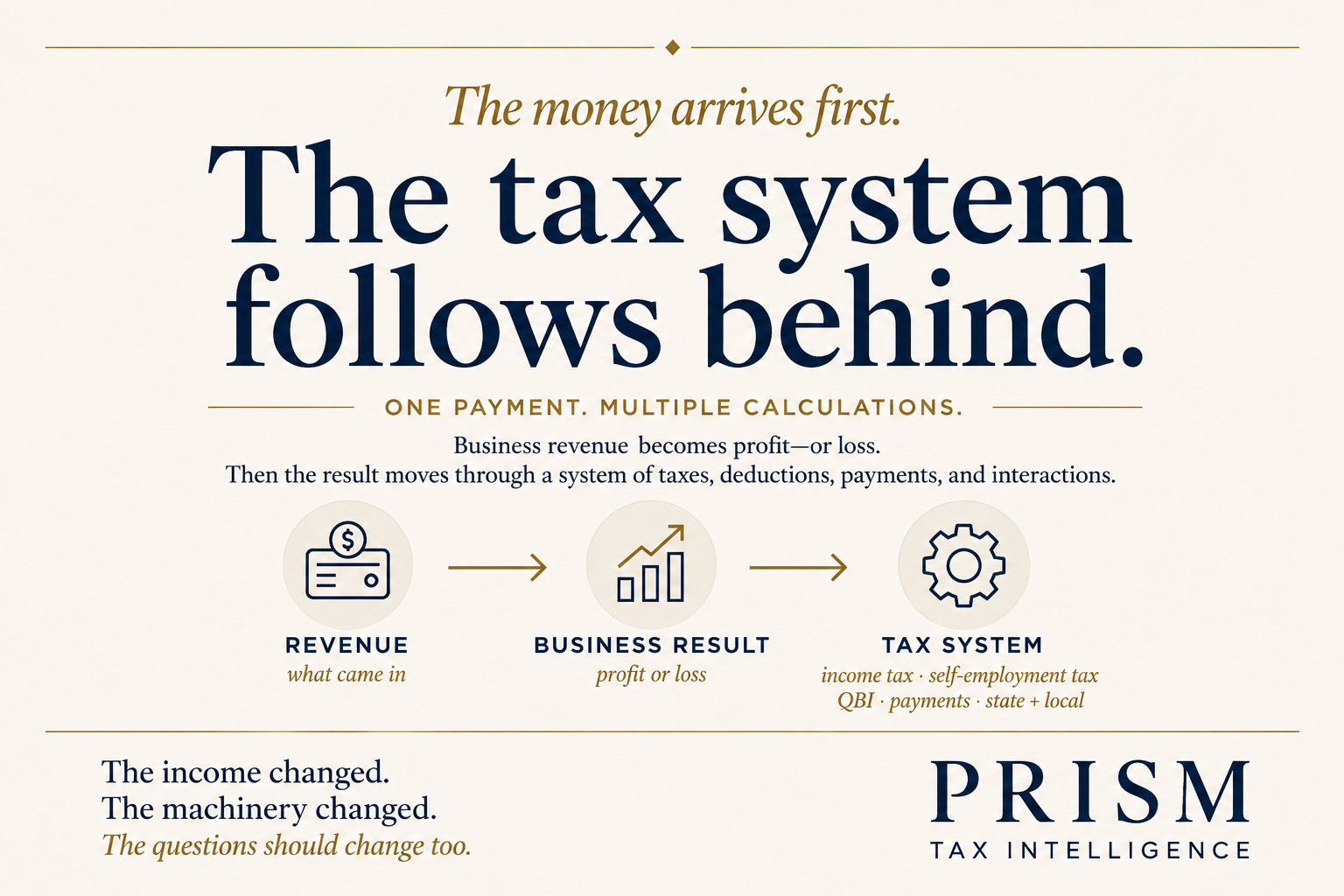
Working for yourself changes the sequence:
You earn business revenue
Business costs are accounted for
Revenue becomes business profit or loss
The result enters multiple tax calculations
Enough tax may need to be prepaid during the year
You file your return
You’re not simply receiving a different kind of paycheck.
The system around the income has changed.
Revenue is not the same thing as profit
Suppose clients pay you $80,000 during the year.
That does not automatically mean you have $80,000 of taxable business profit.
At a high level, a Schedule C business starts with something closer to:
Your bank account can show deposits. A payment processor can report payments. A client can send you a Form 1099.
None of those, by themselves, calculate your taxable business profit.
And the reporting rules don’t determine whether income is taxable.
For payments made in 2026, certain nonemployee compensation generally reaches the federal Form 1099-NEC reporting threshold at $2,000. For third-party network transactions, a third-party settlement organization generally isn’t required to issue Form 1099-K unless payments exceed $20,000 and exceed 200 transactions. Payment-card transactions follow different reporting rules, and a form can sometimes be issued even when a reporting threshold isn’t met.
Those are information-reporting thresholds—not thresholds for whether business income is taxable.
Not receiving a Form 1099 does not necessarily make business income disappear for tax purposes.
The expense side has a similar distinction.
Money leaving your business account isn’t automatically a deduction. A bank statement can help document that money moved, but it doesn’t by itself establish that an expense qualifies for a deduction. The underlying business purpose and applicable tax rules still matter.
What you spent, what you can deduct, and what the deduction ultimately changes on your taxes are three different questions.
That’s the distinction behind PRISM’s What a Deduction Actually Does.
Here, we’re interested in what happens once those rules determine the business result.
Because when the business produces a profit, that profit isn’t the end of the calculation.
It’s an input.
One profit number can affect several tax calculations
This is where the common mental model starts to break.
It would be convenient if self-employment worked like this:
It doesn’t.
When a Schedule C business produces profit, that profit can feed several connected parts of the return:
Schedule C profit
- Regular income tax
- Self-employment tax
- Deduction for part of self-employment tax
- QBI / Section 199A deduction
- Estimated-tax calculations
- State and local taxes, where applicable
These aren’t simply six independent branches.
Some of the calculations can affect others.
That’s why two people with the same amount of Schedule C profit can have different tax outcomes.
One may also have W-2 wages.
One may already be above the Social Security wage base.
Their filing statuses may differ.
Their taxable incomes may differ.
Their businesses may differ.
Their state and local situations may differ.
So the useful question isn’t only:
How much did the business make?
It’s:
What does that profit interact with elsewhere in the return?
“15.3%” isn’t your self-employment tax rate in the way you probably think
You’ve probably encountered some version of this:
Freelancers pay 15.3% self-employment tax.
There is a real number behind that shorthand.
Regular self-employment tax generally includes two components:
That’s where 15.3% comes from.
But that doesn’t mean you can take Schedule C profit, multiply it by 15.3%, and assume you’ve calculated the tax.
Under the regular method, the calculation generally starts by multiplying self-employment earnings—often Schedule C net profit for a sole proprietor—by 92.35%. The Social Security and Medicare components are then calculated from the resulting net earnings, subject to their respective rules.
And those two components don’t behave identically.
For 2026, the Social Security portion is subject to an annual wage base of $184,500. Medicare does not have the same cap.
Existing W-2 wages can matter too.
Consider someone whose W-2 shows:
$184,500 Social Security wages
$190,000 Medicare wages
and who also has:
$30,000 Schedule C profit
Start with the business profit:
$30,000 × 92.35% = $27,705
Because this taxpayer has already used the entire 2026 Social Security wage base through W-2 wages, none of that $27,705 is subject to the 12.4% self-employment Social Security component.
The regular Medicare component remains:
$27,705 × 2.9% = $803.45
Depending on filing status and combined wages and self-employment income, Additional Medicare Tax may also need to be considered separately.
The important number here isn’t $803.45.
It’s the number we didn’t use:
$30,000 × 15.3% = $4,590
That’s why “15.3% of my freelance income” is a shortcut, not a tax model.
The standard deduction doesn’t erase self-employment tax
There’s another reason regular income tax and self-employment tax shouldn’t be treated as the same calculation.
The standard deduction can reduce the amount of income subject to regular federal income tax.
It does not work the same way against self-employment tax.
That means someone can have enough deductions to owe little or even no regular federal income tax while still owing self-employment tax on business earnings.
So:
No regular federal income tax
does not necessarily mean:
No federal tax
Again, the point isn’t to memorize another rule.
It’s to recognize that the same business profit can enter different tax calculations under different rules.
One calculation can change another
Self-employment taxes don’t exist in their own sealed compartment of the return.
For example, part of regular self-employment tax can generally produce an adjustment to income.
That adjustment doesn’t go backward and reduce the Schedule C profit used to calculate the self-employment tax that produced it.
But it can matter elsewhere.
One place these interactions can show up is the Qualified Business Income deduction, or QBI.
The QBI deduction remains available in 2026 under current law. The basic calculation often begins with 20% of qualified business income, before the applicable limitations and special rules are considered.
But beginning in 2026, a new minimum-deduction rule can apply to certain taxpayers who materially participate in qualifying businesses, so “20% of QBI” isn’t a complete universal formula.
And neither is “20% of Schedule C profit.”
Business-attributable adjustments—including the deductible portion of self-employment tax in applicable circumstances—can affect QBI. Other limitations can depend on taxable income, the business, and the taxpayer’s circumstances.
The details can get complicated.
The idea doesn’t have to.
One tax calculation can change another.
That’s why good tax analysis follows interactions rather than isolated rates.
Estimated payments are not another tax
Once someone starts working for themselves, another phrase tends to appear quickly:
quarterly taxes.
That phrase can make it sound like self-employed people have some additional quarterly tax employees don’t have.
They don’t.
Estimated payments are not another tax.
They’re one mechanism for paying toward taxes being generated during the year.
That distinction matters because there are really three different questions:
- Tax liability
- What the year’s tax calculations ultimately produce.
- Tax payments
- What you’ve already paid through withholding, estimated payments, or other applicable payment mechanisms.
- Underpayment exposure
- Whether enough was paid at the required times under the applicable rules.
Those numbers do not have to be the same.
A taxpayer can satisfy an estimated-tax safe harbor and still owe money when the return is filed.
That’s not a contradiction.
The safe-harbor rules address whether enough tax was paid during the year for underpayment-penalty purposes. They do not replace the actual tax calculation.
And estimated payments aren’t necessarily the only way to solve the payment problem.
Someone who also has W-2 wages may be able to adjust withholding from that job. Depending on the circumstances, withholding, estimated payments, or a combination can be used to prepay tax during the year.
For people whose business income arrives unevenly, timing can matter too.
The important distinction is the same one behind PRISM’s Withholding Is Not Tax Liability:
What you’ve paid is not necessarily what you owe.
What if you still have a W-2 job?
Then the two systems exist on the same return.
Your wages don’t stop being wages because you started freelancing.
Your business income doesn’t become wages because you already have a job.
But the two can interact.
We already saw one example: W-2 Social Security wages can consume some or all of the Social Security wage base before self-employment earnings enter that calculation.
At higher income levels, wages and self-employment earnings can also interact when determining whether Additional Medicare Tax applies.
And withholding from the W-2 job may become part of the strategy for covering tax generated elsewhere on the return.
So asking:
What’s the tax rate on my side hustle?
can miss the more important question:
What happens when this business income enters the rest of my return?
An LLC doesn’t automatically change the tax system
Another common transition happens soon after someone starts working for themselves.
They form an LLC.
And that can create another assumption:
I have an LLC now, so my federal taxes must work differently.
Not necessarily.
An LLC is a legal form. Federal tax classification is a separate question.
A domestic single-member LLC is generally disregarded as separate from its owner for federal income-tax purposes unless another classification is elected.
For many individual owners operating an active trade or business, that means the activity can continue to be reported on Schedule C and generally remain within the self-employment-tax framework we’ve been describing.
So:
Forming an LLC
does not automatically mean:
Changing how the business is taxed
But as the business becomes more profitable or the owner’s circumstances change, a different question can become worth examining.
Not:
How does self-employment income work?
But:
Should this business still be taxed this way?
That is where the next decision begins.
If you’re working for yourself in New York City, location adds another layer
Federal tax isn’t necessarily the end of the calculation.
For a New York City resident, business income can affect both New York State and New York City personal income tax.
Separately, operating an unincorporated business in New York City can bring the city’s Unincorporated Business Tax into the picture, depending on the facts.
That doesn’t mean every freelancer simply pays the headline UBT amount. New York City provides a full UBT credit when the calculated liability is $3,400 or less and a partial credit when it is between $3,401 and $5,400. Individual New York City residents may also be able to claim a personal income-tax credit for a portion of UBT paid as a sole proprietor, subject to the applicable rules.
MCTMT adds another location-dependent calculation.
For tax years beginning on or after January 1, 2026, self-employed individuals with more than $150,000 of net earnings attributable to the Metropolitan Commuter Transportation District can become subject to MCTMT.
For Zone 1—which includes New York City—the 2026 self-employment rate is 0.60% of net earnings attributable to that zone when the threshold is exceeded. Zone 2 has a different rate.
That doesn’t mean every New York City freelancer should take a federal calculation and simply add another percentage.
These rules have their own bases, thresholds, credits, geographic rules, and interactions.
The larger point is simpler:
Where you live and where the business operates can both become inputs into the tax system.
So what actually changed?
Not simply your tax rate.
The machinery changed.
As an employee, much of that machinery operated before the money reached you.
Working for yourself means business revenue has to be translated into business profit—or loss—for tax purposes.
That result can enter several connected tax calculations.
Some of those calculations can change others.
And you take greater responsibility for how enough of the resulting tax gets paid during the year.
Once you can see that system, better questions become possible.
What is actually driving my tax result?
What changes if the business earns more?
What changes because I still have wages?
What needs to be paid before the return is filed?
And eventually:
Should this business still be taxed this way?
Source notes
- IRS, Instructions for Forms 1099-MISC and 1099-NEC — nonemployee compensation reporting
- IRS, Understanding Your Form 1099-K — third-party network and payment-card reporting
- IRS, Instructions for Schedule C (Form 1040) — profit or loss from business
- IRS, Self-Employment Tax (Social Security and Medicare Taxes)
- IRS, Instructions for Schedule SE (Form 1040) — 92.35% net earnings calculation and the deduction for part of self-employment tax
- Social Security Administration, Contribution and Benefit Base
- IRS, Topic No. 560, Additional Medicare Tax
- IRS, Qualified Business Income Deduction (Section 199A)
- 26 U.S.C. §199A — Qualified business income
- IRS, Estimated Taxes; Publication 505, Tax Withholding and Estimated Tax
- IRS, Single Member Limited Liability Companies — federal classification
- NYC Department of Finance, Unincorporated Business Tax (UBT) and UBT credits
- NYS Department of Taxation and Finance, Metropolitan commuter transportation mobility tax (MCTMT)
General information only. This article does not constitute individualized tax, legal, accounting, or investment advice and does not create a professional-client relationship. Tax treatment depends on the taxpayer’s complete facts and circumstances.
Your business income doesn’t exist in isolation.
The article shows the system. The PRISM Workspace lets you explore how business profit, W-2 wages, tax payments, and other variables can interact when the facts change.
Exploring the model is educational. It does not produce professional advice or a definitive tax result, particularly when the required facts are incomplete.
LLC vs. S Corporation: What Actually Changes for Taxes?
Once you understand how self-employment income is taxed, the next question is whether the business should continue to be taxed that way.
In preparation