Business owners are taught to love deductions.
Spend money on the business. Reduce taxable income. Save taxes.
Simple.
Until it isn’t.
Because three numbers that sound almost interchangeable are doing three very different jobs:
What you spent.
What you deducted.
What you saved in tax.
Those numbers are not the same.
And confusing them can make a perfectly legitimate tax strategy look much better economically than it really is.
Start with the business, not the tax return
Imagine your business has $100,000 of profit before one additional year-end purchase.
You spend $30,000.
Assume, purely for this illustration, that the entire $30,000 qualifies as a current Schedule C deduction.
The business arithmetic is easy:
$100,000 of business profit.
Minus a $30,000 current Schedule C expense.
$70,000 of business profit remains.
That’s the first side of the pyramid.
Spend more on qualifying current Schedule C expenses and, all else equal, there’s less Schedule C profit left.
But notice what happened before we ever talked about taxes.
The business spent $30,000.
Real money left.
The deduction did not undo that.
Now flip the pyramid
This is where the same decision starts to look different.
The $30,000 expenditure reduced business profit from $100,000 to $70,000.
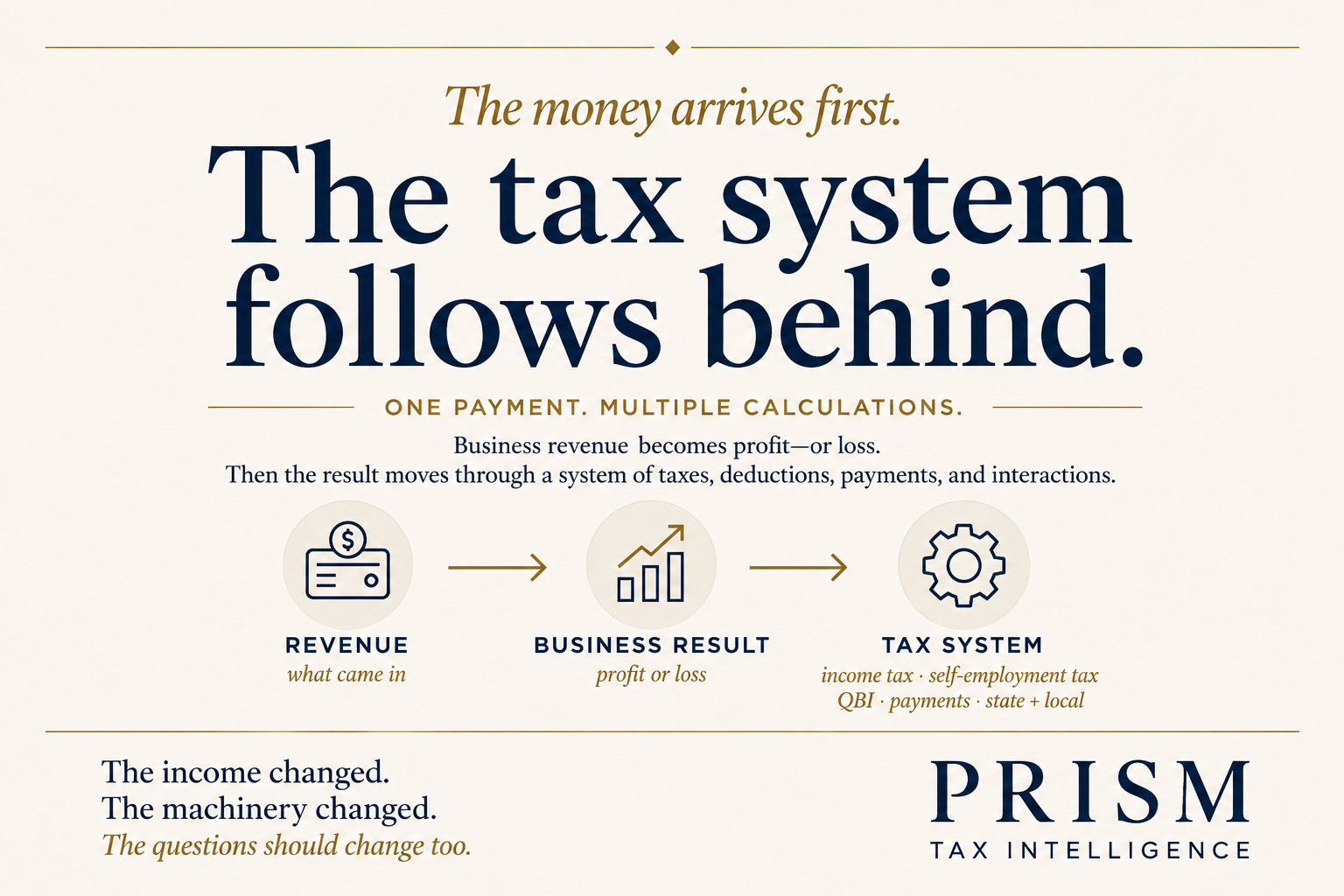
That lower profit can then affect more than one part of the federal tax calculation.
There can be an income-tax effect.
There can also be a self-employment-tax effect.
And those effects do not necessarily move in exactly the same way.
The Prism Pyramid
What happens when you spend $30,000 for a deduction?
Assume the full expense qualifies as a current Schedule C deduction.
The business effect
- Business profit
- $100,000
- Current Schedule C expense
- − $30,000
- $70,000
- Business profit after expense
$30,000 left the business.
$30,000 left the business-profit calculation.
Business profit $100,000 less current Schedule C expense $30,000 equals $70,000 business profit after expense.
The deduction is not the savings
This is the distinction that gets lost.
If you spend $30,000 and receive a $30,000 current deduction, you did not “save $30,000.”
You spent $30,000.
The deduction changed the tax calculation attached to that spending.
How much tax changes depends on the rest of the return.
For federal income tax, the effect depends on taxable income, the applicable marginal rate, other deductions, and other return items.
Self-employment tax has its own mechanics.
Under the regular method, net earnings from self-employment are generally calculated using a 92.35% adjustment before the Social Security and Medicare components of self-employment tax are applied.
W-2 wages can affect how much of the Social Security component remains applicable.
A deductible portion of self-employment tax then creates another effect elsewhere on the individual return.
So this isn’t:
$30,000 deduction × one tax rate = answer.
And there can be another force moving in the opposite direction.
For an eligible business owner, a deductible business expense can also reduce qualified business income and, in turn, reduce the §199A qualified business income deduction.
So an expense can reduce the income being taxed while also reducing a deduction tied to that income.
That doesn’t make the expense good or bad.
It makes the tax effect more interconnected than “deduction × tax rate.”
The tax side has its own pyramid.
The expense still has to make sense
This is the part tax conversations often skip.
Suppose the business was already going to buy the equipment.
It needs the equipment.
The economics work.
The timing is flexible.
Now tax planning can matter.
Maybe you were going to make the investment in January anyway, and there is a legitimate reason to understand what changes if it happens in December.
Tax treatment can affect timing.
It can reduce the after-tax economic cost of a decision the business already has a reason to make.
That’s planning.
But reverse the order.
The business does not need the purchase.
The economics do not justify it.
The only reason to spend $30,000 is:
“I need a deduction.”
Now the tax tail is wagging the business dog.
You are spending a dollar to avoid paying some fraction of a dollar in tax.
The deduction may be perfectly valid.
The decision can still be bad.
Not every business purchase reaches the pyramid the same way
There is another reason “I spent it, therefore I deducted it” fails.
The tax system does not treat every business expenditure the same way.
Some costs may qualify as current Schedule C expenses.
Some may be partly business and partly personal.
Some deductions are limited.
Some costs may be capitalized and recovered under depreciation rules.
Inventory and cost of goods sold follow their own framework.
Certain deductions associated with self-employment belong elsewhere on the individual return rather than on Schedule C itself.
And some costs simply are not deductible.
That distinction matters because the pyramid starts only after you know what the expenditure actually is for tax purposes.
The first question isn’t:
How much did I spend?
It is:
What did I spend it on, and how does the tax law treat it?
A receipt proves less than people think
A receipt can establish that money changed hands.
It does not automatically establish why the expense is deductible.
Tax substantiation can require evidence of amount, timing, place, business purpose, business relationship, or other facts depending on the type of expense.
Certain expenses governed by heightened substantiation rules can qualify for a documentary-evidence exception below $75, with lodging being an important exception.
But that is not a universal “under $75 means no records” rule.
The IRS doesn’t suddenly stop caring what happened because a covered expense was $74 instead of $76.
The underlying business purpose and other required elements still matter.
The lesson is simple:
Proof that you paid is not always proof that you can deduct.
The pyramid works in both directions
Most people approach deductions from the tax side.
How much can I deduct?
How much tax will I save?
What can I buy before year-end?
The Prism Pyramid starts from the other direction.
What does the business actually need?
What economic decision are you already considering?
How will that decision be treated for tax purposes?
What does that treatment change?
That order matters.
Because the purpose of tax planning is not to maximize deductions in isolation.
It is to understand how tax consequences change the economics of decisions that still have to make sense on their own.
Preparation comes after the decision
By the time a tax return is being prepared, most of these facts already exist.
The money was spent or it wasn’t.
The expense had a business purpose or it didn’t.
The equipment was placed in service or it wasn’t.
The records exist or they don’t.
The return reports that history.
Planning happens earlier, while there is still something to decide.
That is the real value of understanding the pyramid before year-end.
Not because every business should spend more.
Not because deductions are free money.
And not because a lower tax bill automatically means a better decision.
Because when the facts are still being formed, you can see both sides at once:
the business effect
and
the tax effect.
The better question
So when someone says:
“I can spend $30,000 and deduct it.”
The next question should not be:
“How much does that save me?”
Start one step earlier.
Ask:
“Would the business still want to spend the $30,000 if there were no deduction?”
If the answer is yes, tax treatment may improve the economics of a decision that already makes sense.
If the answer is no, the deduction deserves a much harder look.
Because a deduction can reduce taxable income.
It can reduce tax.
It can change timing.
It can change after-tax economic cost.
But it cannot turn an unnecessary expense into a necessary one.
Tax treatment can change the economics of a decision.
It can’t decide whether the decision was worth making.
Educational information only. This article does not constitute tax, legal, accounting, or investment advice. Tax treatment depends on the taxpayer’s complete facts and circumstances.