What Is Self-Employment Income?
Getting paid is only part of the question. The activity behind the income matters too.
Self-employment income generally means income you earn from carrying on a trade or business for yourself. The important question is not simply whether someone paid you, whether you received a 1099, or whether you formed an LLC. The activity behind the income matters.
For federal tax purposes, a trade or business generally involves an activity carried on with a primary purpose of earning income or profit and with continuity and regularity. Sporadic activities, personal transactions, investment income, and hobby activity can be treated differently depending on the facts.
You also do not need an LLC or formal business entity to be self-employed. Someone operating a business individually may be a sole proprietor for federal tax purposes.
For a sole proprietor, business income and expenses are generally reported on Schedule C. Net earnings from self-employment can also be subject to self-employment tax, generally when they reach $400 or more.
The key distinction is simple: self-employment income follows the nature of the activity—not merely the payment or the paperwork.
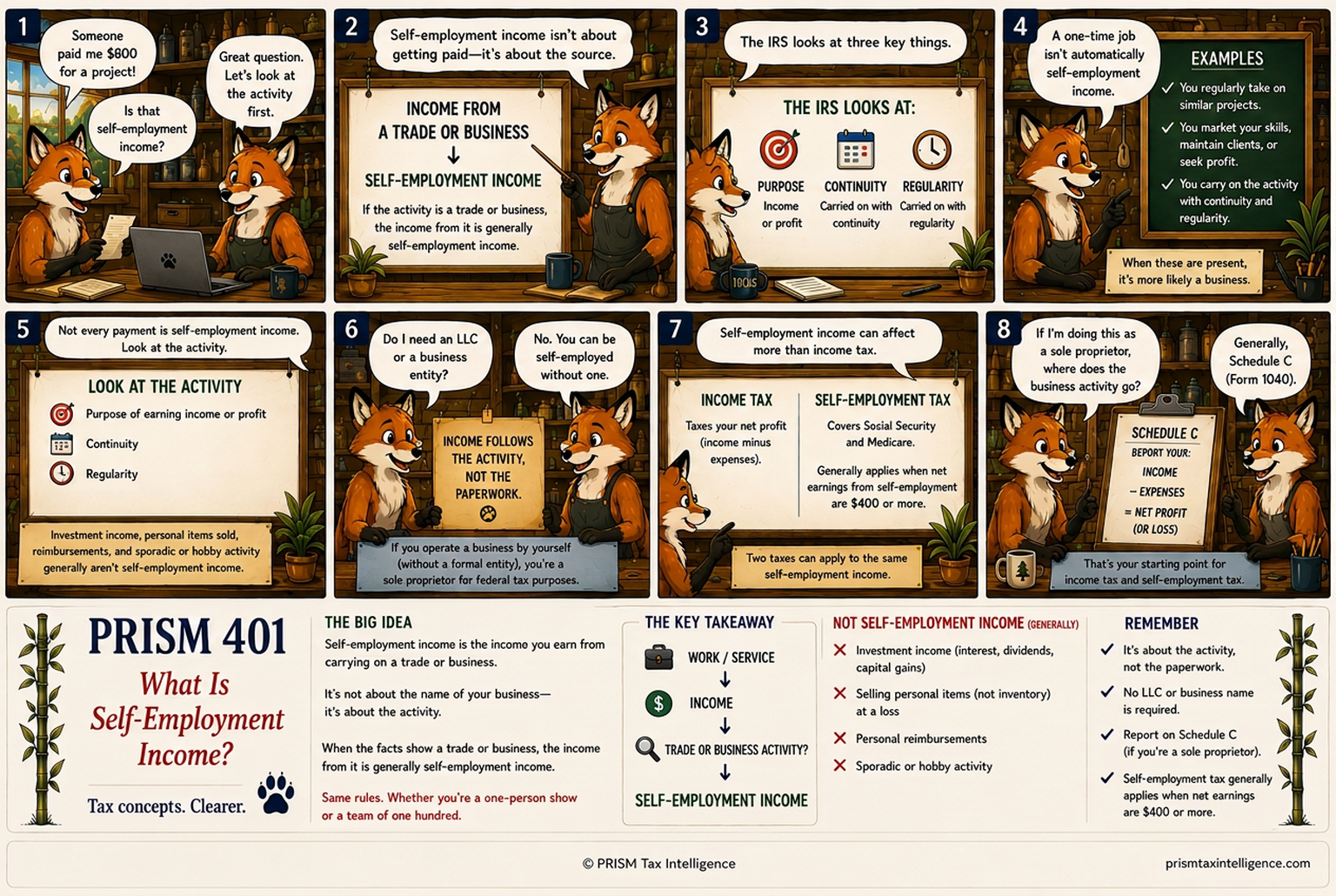
Image revision r2 · · 1536x1030
- File:
- /prism-401-what-is-self-employment-income.png
- sha256:
- be8255d60e978c1b
- Social preview:
- /og-prism-401.jpg (65fca6eb19faede4)
r2 · 2026-08-15 — Text-only correction pass. Artwork, layout, and panel order unchanged.
- Panel 3 — removed “The facts and circumstances matter.”
- Panel 5 — removed “The facts and circumstances matter.”
- Reference strip — removed “When in doubt, look at the facts and the pattern.”
- Bottom bar — removed the warning text and triangle icon; kept © PRISM Tax Intelligence and prismtaxintelligence.com.
- “Generally” qualifiers retained throughout.
- Social preview /og-prism-401.jpg regenerated from this revision (1200x630).
r1 · 2026-08-15 — Initial published PRISM 401 illustration.
- First release alongside the PRISM 401 lesson page and social preview.
What to Remember
Self-employment is about the activity, not merely the paperwork surrounding it. A person does not need an LLC, corporation, or formal business name to potentially be self-employed.
The trade-or-business question looks at the facts and circumstances, including whether the activity is pursued for income or profit and carried on with continuity and regularity. A sporadic payment or isolated transaction should not automatically be treated the same as an ongoing business activity.
For a sole proprietor, Schedule C generally reports the income and expenses of the business and determines its net profit or loss. Self-employment tax is a separate calculation, generally applying when net earnings from self-employment are $400 or more.
What Makes an Activity a Trade or Business?
Getting paid does not, by itself, answer whether income is self-employment income.
For Schedule C purposes, the IRS generally looks for an activity whose primary purpose is income or profit and that is conducted with continuity and regularity.
That distinction matters because not every way of receiving money represents a trade or business. Investment income, sales of personal property, reimbursements, sporadic activity, and hobby activity may fall under different tax rules.
Work or service↓Income↓Trade or business activity?↓Self-employment income
The classification depends on the underlying facts and circumstances.
Do You Need an LLC to Be Self-Employed?
No.
An LLC is a legal entity structure. Self-employment is a federal tax concept tied to the activity being carried on.
A person who operates a business individually without forming a separate entity may be treated as a sole proprietor for federal tax purposes.
That is why forming an LLC is not what creates self-employment income.
The income follows the activity—not the paperwork.
How Is Self-Employment Income Taxed?
Self-employment income can affect more than one part of a federal tax return.
Net business profit generally participates in the federal income-tax calculation. Net earnings from self-employment may also be subject to self-employment tax, which generally covers Social Security and Medicare taxes for self-employed individuals.
Generally, self-employment tax applies when net earnings from self-employment are $400 or more.
Where Does a Sole Proprietor Report Business Activity?
A sole proprietor generally reports the income and expenses of a trade or business on Schedule C (Form 1040), Profit or Loss From Business.
Business income− Deductible business expenses= Net profit or loss
Schedule C determines business profit or loss. Schedule SE is used to calculate self-employment tax when applicable.
Not Every Payment Is Self-Employment Income
Money can reach a taxpayer in many different ways. The source and character of the payment matter.
Self-employment income vs. wages
Wages paid to an employee are generally employee compensation rather than self-employment income. Worker classification depends on the underlying relationship, not simply what the parties call it.
Self-employment income vs. investment income
Interest, dividends, and capital gains are generally investment income rather than self-employment income, subject to specialized exceptions.
Self-employment income vs. selling personal property
Selling your own personal property does not automatically mean you are operating a trade or business. The tax treatment of a personal-property sale depends on the transaction and applicable tax rules.
Self-employment income vs. hobby or sporadic activity
An activity that is sporadic or not carried on as a trade or business should not automatically be classified as self-employment activity. Facts and circumstances matter.
Frequently Asked Questions
- What counts as self-employment income?
- Self-employment income generally arises from carrying on a trade or business for yourself. The analysis focuses on the nature of the activity, including its profit or income purpose and whether it is conducted with continuity and regularity.
- Do I need an LLC to have self-employment income?
- No. A person can be self-employed without forming an LLC or corporation. Someone operating a business individually may be treated as a sole proprietor for federal tax purposes.
- Does receiving a 1099 automatically make me self-employed?
- Not necessarily. An information return can help report a payment, but the tax treatment depends on the underlying activity and relationship. The form itself does not determine whether an activity constitutes a trade or business.
- Where does a sole proprietor report self-employment income?
- A sole proprietor generally reports business income and deductible business expenses on Schedule C (Form 1040). Schedule SE is used to calculate self-employment tax when applicable.
- When does self-employment tax apply?
- Generally, self-employment tax applies when net earnings from self-employment are $400 or more. Additional rules and exceptions can affect the calculation.
Go Deeper
- Ordinary Income
How income can carry different tax character.
- Marginal Rate vs. Effective Rate
Why a tax rate does not necessarily describe the rate applied to every dollar.
- Withholding Is Not Your Tax Liability
The distinction between tax paid during the year and final tax liability.
- 15 Questions Your Tax Preparer Should Have Asked You
The questions that surface income earned outside payroll.
- PRISM 402 — What Is a Business Expense?
Spending money is only part of the question. Learn why business purpose, use, substantiation, and tax treatment determine what happens next.
Primary Sources
- IRS — Self-Employed Individuals Tax Center.
Provides IRS guidance on who is self-employed, filing obligations, and how business activity is reported.
- IRS Topic No. 554 — Self-Employment Tax.
Explains self-employment tax, including the general $400 net-earnings threshold.
- Schedule C (Form 1040) — Profit or Loss From Business.
The form and instructions a sole proprietor generally uses to report business income and expenses.
- Schedule SE (Form 1040) — Self-Employment Tax.
The form and instructions used to calculate self-employment tax when it applies.
- IRS — Business activities and not-for-profit activities.
Provides IRS guidance addressing the distinction between a business activity and an activity not engaged in for profit.
This material is for general educational purposes and does not constitute individualized tax advice. Tax treatment depends on the facts and circumstances, and specialized rules may apply.
More foundational concepts are published in Tax Code, Simplified.