What Is a Business Expense?
Spending money is only part of the question. The reason behind the expense matters too.
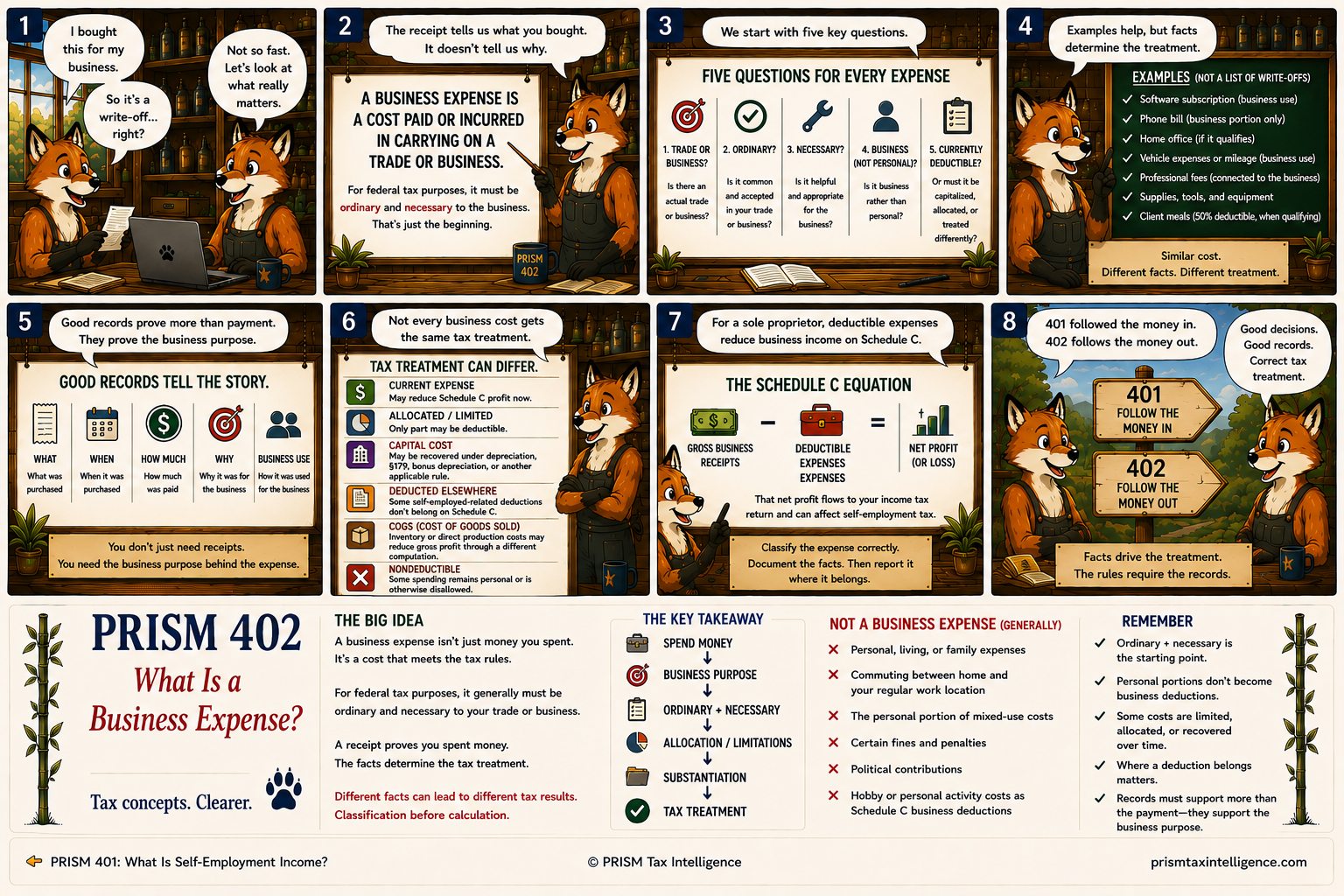
A business expense generally means a cost paid or incurred in carrying on a trade or business. For federal income-tax purposes, deductible business expenses generally must be ordinary and necessary to the business. But those words do not mean “anything you spent while working.”
An expense can look business-related and still require a closer look. Some costs are personal. Some have both business and personal use. Some must be treated differently under specific tax rules. And some may be legitimate business costs but still require records that establish what was purchased, how much was paid, and the business purpose.
The important distinction is simple: spending money does not create a deduction. The business purpose and tax treatment of the expense determine what happens next.
For a sole proprietor, deductible business expenses generally reduce business income reported on Schedule C in arriving at net profit or loss.
Business income− Deductible business expenses= Net profit or loss
What to Remember
A receipt proves that money was spent. It does not, by itself, prove that the spending was a deductible business expense.
For federal income-tax purposes, a business expense generally must have a legitimate connection to carrying on the trade or business and satisfy the rules applicable to that particular type of expense.
The IRS commonly describes deductible business expenses as ordinary and necessary. “Ordinary” generally means common and accepted in the taxpayer’s trade or business. “Necessary” generally means helpful and appropriate for the business. It does not have to be absolutely indispensable.
But that is the beginning of the analysis, not the end. Personal expenses generally are not deductible as business expenses. When something serves both business and personal purposes, the deductible treatment may depend on identifying and substantiating the business portion. And certain expenses are subject to additional limitations or entirely different rules.
What Does “Ordinary and Necessary” Actually Mean?
Those two words carry a lot of weight in business-tax conversations. They are also easy to misunderstand.
Ordinary does not mean mandatory
An expense does not have to be something every business purchases. The question is generally whether the type of expense is common and accepted in the particular trade or business.
Necessary does not mean essential for survival
An expense may be necessary for federal tax purposes when it is helpful and appropriate for carrying on the business.
That means the analysis is contextual. A software subscription used to perform client work may have an obvious business connection for one business. The same subscription purchased primarily for personal use may present a very different question.
The object itself does not determine the deduction. The facts surrounding its use matter.
Does Buying Something for Work Automatically Make It Deductible?
No.
A taxpayer can spend money because of work without every dollar automatically becoming a deductible Schedule C expense. The expense still has to be evaluated under the tax rules that apply to it.
Money spent↓Business purpose?↓Ordinary + necessary?↓Personal use or special limitation?↓Substantiation↓Tax treatment
This is why “Can I write this off?” is often not a yes-or-no question based solely on the name of the purchase.
The better question is: what was the expense for, and how was it actually used?
What If an Expense Is Part Business and Part Personal?
This is where many seemingly simple expenses become more nuanced. A phone, vehicle, internet connection, home, or other item may serve both business and personal purposes.
That does not necessarily mean the entire expense is deductible. It also does not necessarily mean none of it is. Depending on the expense and the applicable rules, the business portion may need to be separated from the personal portion.
The important concept is allocation. If an expense is only partially attributable to business activity, tax treatment may depend on establishing a reasonable business portion and satisfying any additional requirements that apply to that category of expense.
Business purpose does not convert the personal portion into a business deduction.
Does Having a Receipt Make an Expense Deductible?
No.
A receipt can be important evidence, but it answers only part of the question.
A receipt may help establish
- what was purchased
- when it was purchased
- how much was paid
It may not, by itself, establish
- why the expense was incurred
- how it related to the business
- whether there was personal use
- what portion was business-related
Different categories of expenses can carry different recordkeeping requirements, and certain categories are subject to heightened substantiation rules that do not apply to every business expense.
So good records are not merely a pile of receipts. They help establish the business story behind the transaction.
Where Do Sole Proprietors Report Business Expenses?
For a sole proprietor, business income and deductible business expenses are generally reported on Schedule C, Profit or Loss From Business, filed with the individual’s Form 1040.
Schedule C does more than collect a list of deductions. It calculates the net result of the business:
Gross business income− Deductible business expenses= Net profit or loss
That net result can then affect other parts of the federal tax return.
This is why PRISM 401 and PRISM 402 belong together. 401 asks what belongs in business income. 402 asks what belongs in business expenses. Neither question is answered merely by looking at whether money entered or left a bank account.
Not Every Business Cost Is Treated the Same Way
“Business expense” is a useful general concept, but federal tax law contains different rules for different types of costs.
- Current expense
- A qualifying cost may be currently deductible and may reduce Schedule C profit.
- Allocated or limited cost
- Only the qualifying business portion may be deductible, or another limitation may apply.
- Capital cost
- Some costs may need to be capitalized or recovered under depreciation, Section 179, bonus depreciation, or another applicable rule rather than being treated as an ordinary current expense.
- Deducted elsewhere
- Some deductions associated with self-employment do not belong on Schedule C and may instead be reported elsewhere on the individual income-tax return.
- Cost of goods sold
- Inventory or direct production costs may reduce gross profit through the cost-of-goods-sold computation rather than being treated as ordinary Schedule C operating expenses.
- Nondeductible
- Some spending remains personal or is otherwise nondeductible under applicable federal tax rules.
That is why a list titled “Everything Freelancers Can Write Off” can be misleading. The category tells you where to start. The facts determine where you finish.
Frequently Asked Questions
- What counts as a business expense?
- A business expense generally is a cost paid or incurred in carrying on a trade or business. For federal income-tax purposes, deductible business expenses generally must be ordinary and necessary, although additional rules and limitations can apply depending on the type of expense.
- What does “ordinary and necessary” mean?
- An ordinary expense generally is common and accepted in the taxpayer’s trade or business. A necessary expense generally is helpful and appropriate for the business. “Necessary” does not mean the expense must be indispensable.
- Can I deduct something just because I use it for work?
- Not necessarily. The federal tax treatment depends on the nature of the expense, its business purpose, the extent of any personal use, applicable limitations, and the supporting records.
- What if I use something for both business and personal purposes?
- Some mixed-use expenses may require allocation between business and personal use. The rules vary depending on the particular expense, so the entire cost should not automatically be treated as a business deduction.
- Is a receipt enough to prove a business expense?
- A receipt can establish important details about a purchase, but it may not establish the business purpose or business-use percentage. Appropriate substantiation depends on the expense and the applicable tax rules.
- Where does a sole proprietor deduct business expenses?
- A sole proprietor generally reports business income and deductible business expenses on Schedule C filed with Form 1040. Schedule C calculates the business’s net profit or loss.
Go Deeper
- PRISM 401 — What Is Self-Employment Income?
Follow the money in: why the activity producing the income matters more than the paperwork.
- Ordinary Income
How income can carry different tax character before any expense analysis begins.
- Withholding Is Not Your Tax Liability
The distinction between tax paid during the year and final tax liability.
- 15 Questions Your Tax Preparer Should Have Asked You
The questions that surface income earned outside payroll and the costs of earning it.
Primary Sources
- IRC §162 — Trade or business expenses.
Provides the statutory allowance for ordinary and necessary expenses paid or incurred in carrying on a trade or business.
- IRC §262 — Personal, living, and family expenses.
Provides the general rule disallowing deductions for personal, living, and family expenses.
- IRC §263 — Capital expenditures.
Addresses costs that generally must be capitalized rather than treated as a current expense.
- IRS — Deducting business expenses.
Current IRS guidance describing deductible business expenses and the ordinary-and-necessary concept.
- Schedule C (Form 1040) — Profit or Loss From Business.
The form and instructions a sole proprietor generally uses to report business income and deductible business expenses.
- IRS — Recordkeeping.
Provides IRS guidance on the records that support items reported on a business return.
- IRC §274 — Disallowance of certain entertainment, etc., expenses.
Provides additional limitations and heightened substantiation requirements applicable to certain categories of expenses.
This material is for general educational purposes and does not constitute individualized tax advice. Tax treatment depends on the facts and circumstances, and specialized rules may apply.
More foundational concepts are published in Tax Code, Simplified.