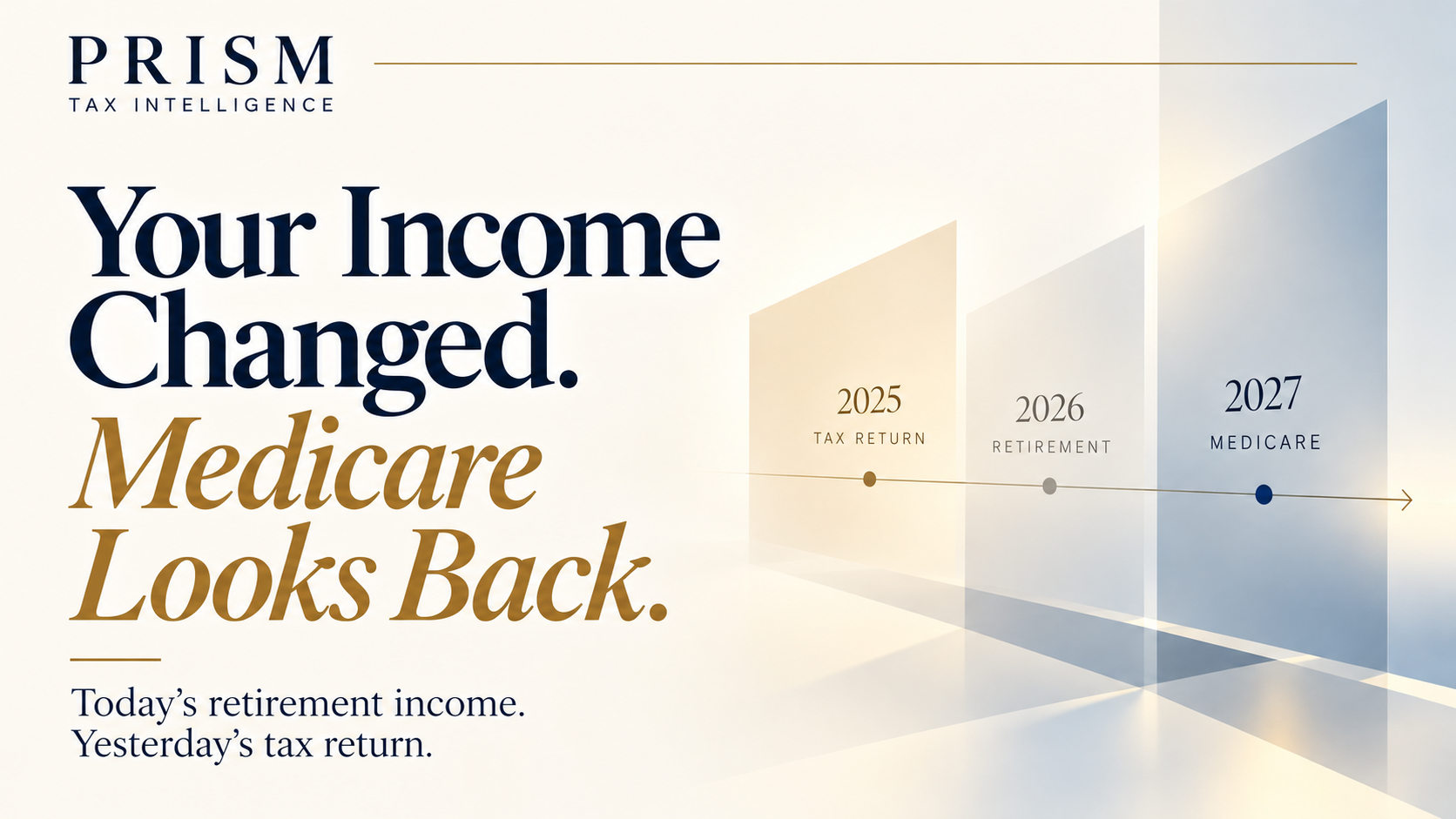
Retirement changes your income. Medicare may still be looking at the years before you retired.
You retire, your paycheck stops, and your household adjusts to a different income.
Then your Medicare premium arrives.
Social Security is still using income from when you were working.
It feels outdated because, in a sense, it is. But that doesn’t necessarily mean Social Security made a mistake.
Medicare generally uses tax information from two years earlier to determine whether you owe an income-related premium adjustment, known as IRMAA.
For 2027, that usually means your 2025 tax return.
If you retired in 2026, your Medicare premiums may still reflect your old salary.
The question isn’t simply whether your income dropped. It’s why it dropped.
When retirement can make a difference
Social Security recognizes certain life-changing events that may justify using more recent income information.
Two common examples are stopping work and reducing working hours.
If either causes a sufficiently large reduction in your modified adjusted gross income to lower your IRMAA, you may qualify for a new initial determination.
Form SSA-44 provides a way to request this review.
You generally need evidence of the qualifying event, such as an employer statement or retirement documentation, along with appropriate information about your newer income.
You don’t necessarily have to wait two more years for the ordinary tax-return lookback to catch up.
But the reduction must actually affect your IRMAA level. Retirement alone doesn’t guarantee a lower premium.
Other qualifying events include marriage, divorce, death of a spouse, and certain qualifying losses of property or pension income.
PRISM Lookback
Yesterday’s return. Today’s income.
A fictional retiree: work stops in 2026. Both bars share one scale.
Social Security generally uses tax information from two years earlier. For 2027 Medicare premiums, that ordinarily means the 2025 return.
Difference from 2025 MAGI
$175,000 lower
Estimated income is lower than historical income. A qualifying life-changing event may permit Social Security to consider newer information.
Educational illustration only. Moving the income slider does not establish eligibility for a new IRMAA determination.
What if your income increased only once?
This is where the rules become less intuitive.
Suppose you completed a large Roth conversion in 2025.
The taxable conversion increased your income, which may increase your 2027 Medicare premiums.
You don’t plan to convert that amount again. Your income has returned to normal.
Can Social Security disregard it?
Generally, no.
A Roth conversion isn’t, by itself, a qualifying life-changing event. Neither is an ordinary one-time capital gain or a large retirement-account withdrawal.
The income may be temporary, but it was still part of the relevant tax calculation.
There is another distinction worth understanding.
If you retired and also completed a Roth conversion, the retirement may qualify as a life-changing event. But Social Security still considers the conversion when evaluating your applicable income.
One event doesn’t erase the other.
What if the tax information was incorrect?
Not every Medicare premium problem requires SSA-44.
Consider three different situations:
- Your tax return was amended. Social Security has a procedure for reviewing properly documented amended federal returns.
- The IRS supplied incorrect information. A separate correction procedure may apply when the return was accurate but the information transmitted to Social Security was wrong.
- Social Security used an even older return. If the normal two-year information was unavailable, SSA may have used information from three years earlier. There is a procedure for requesting use of the appropriate two-year information when it becomes available.
These situations do not require a qualifying retirement event.
Formal reconsideration is different again.
When a beneficiary disputes an IRMAA determination, a formal appeal may be appropriate. Form SSA-561 is used for reconsideration, and the filing deadline is generally 60 days after receiving the notice, subject to applicable receipt and extension rules.
Submitting SSA-44 should not be assumed to preserve that separate appeal deadline.
Where should you start?
Before requesting a change, review the Medicare IRMAA notice and identify:
- The tax year and income Social Security used.
- Whether that information is accurate.
- What changed, and when.
- Whether the issue involves a qualifying life event, corrected tax information, or a disputed determination.
The answers help identify the appropriate procedure and supporting documents.
A favorable determination may also result in adjustment or refund of excess IRMAA for an eligible period, subject to SSA’s effective-date rules.
The part of retirement planning that is easy to miss
A financial decision can have consequences long after the tax return is filed.
A Roth conversion or investment sale might make sense for one tax year while increasing Medicare premiums in another.
And retirement may change someone’s income immediately, even though the government’s calculation still reflects an earlier financial life.
We explored those connections in our earlier PRISM Library article:
You Retired. Your Income Dropped. Should You Fill the Gap?
The important distinction is between planning an income decision before it occurs and understanding what administrative remedies may exist afterward.
An accurate tax return can produce an accurate Medicare premium calculation. That doesn’t always mean the original determination is the only one Social Security is permitted to make.
Sources
The example in this article is fictional and educational. It does not calculate Medicare premiums or IRMAA amounts and is not an individualized determination.
PRISM Tax Intelligence
Complex tax decisions. Clearly understood.