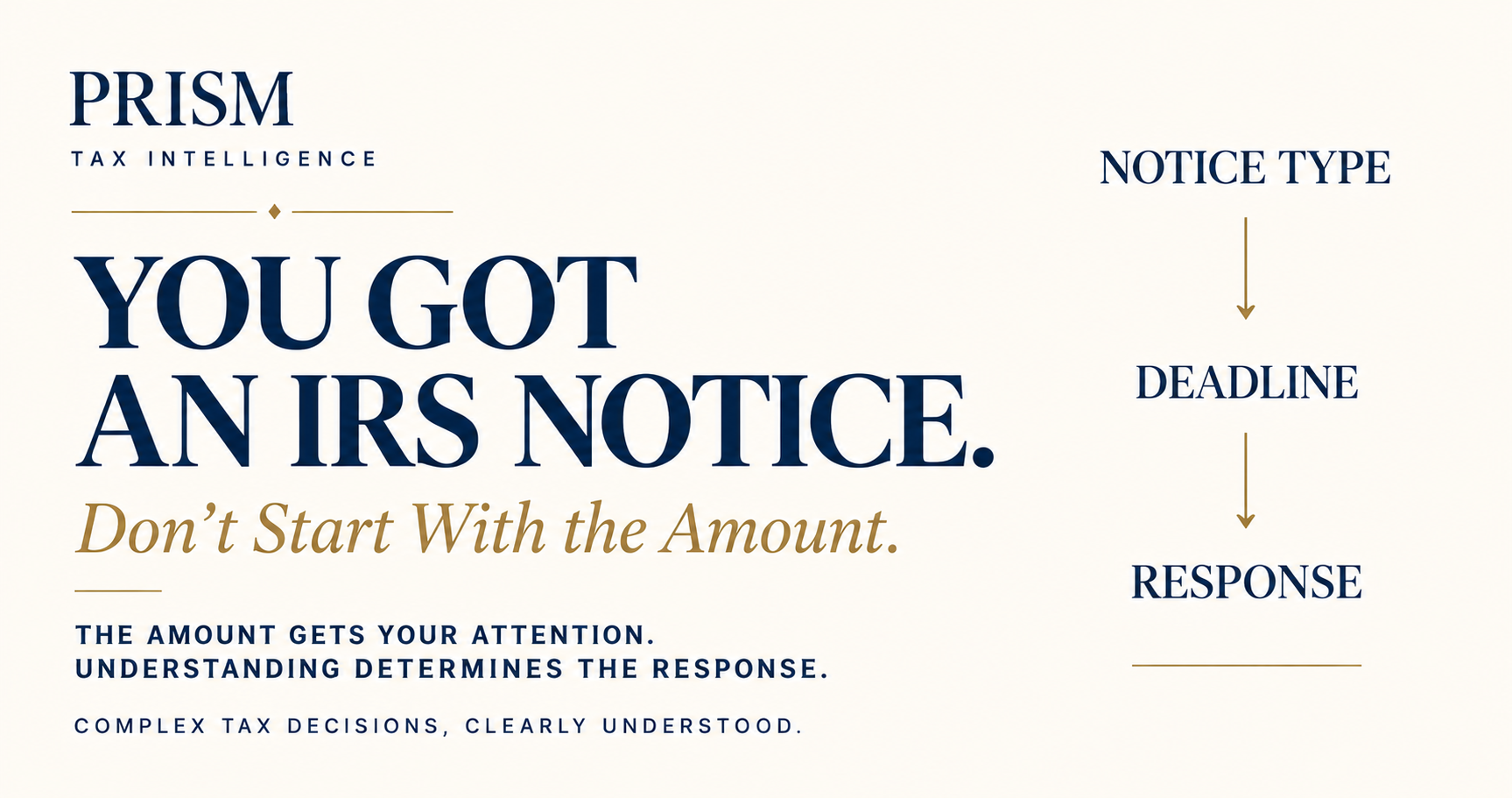
You Got an IRS Notice. The Amount Is Not the First Thing to Understand.
An IRS notice can put a number in front of you before you understand what produced it. Before you pay it, dispute it, or ignore it, first understand what the IRS is actually doing—and what date may control what happens next.
PRISM Tax Intelligence·Published September 17, 2026·11 min read
An IRS notice can put a number in front of you before you understand what produced it. Before you pay it, dispute it, or ignore it, first understand what the IRS is actually doing—and what date may control what happens next.
The envelope arrives.
You open it.
Your eyes go straight to the number.
Maybe the IRS says you owe $2,000. Maybe it says $20,000. Maybe the amount is large enough that everything else on the page becomes background.
The instinct is understandable:
Do I owe this?
But that may not be the first question the notice is asking you to answer.
An IRS notice can request information. It can propose a change. It can reflect tax that has already been assessed. It can ask you to verify your identity. It can concern collection of an unpaid balance. Or it can carry a statutory right that disappears if you do not act within a particular period.
Those are very different situations.
So before reacting to the amount, start somewhere else.
What kind of notice is this?
And then:
What date matters?
The first number to find may not be the dollar amount. It may be the date.
There is no universal deadline for responding to the IRS.
A CP2000 proposed-adjustment notice ordinarily has an administrative response period. Certain math-error notices carry a separate statutory period for requesting abatement. A statutory notice of deficiency can carry a Tax Court petition deadline. Certain collection notices can create different hearing rights and different deadlines again.
The differences are not technical trivia.
They can determine what options remain available to you.
That means the first step isn't simply:
HOW MUCH DOES THE IRS SAY I OWE?
It is:
WHAT IS THIS NOTICE DOING?
WHAT PROCEDURAL STAGE AM I IN?
WHAT DATE OR RIGHT IS AT RISK?
Only then does the dollar amount have the context it needs.
A number on a notice can mean different things.
The phrase “IRS notice” sounds like one category.
It isn't.
A notice might show a proposed adjustment that has not yet become an ordinary assessment.
Another might show tax that has already been assessed and remains unpaid.
Another might concern collection of an existing liability.
And some IRS correspondence does not assert additional tax at all. It may be asking for information or identity verification.
That is why this statement is useful but incomplete:
THE NUMBER ON THE NOTICE ≠ THE AMOUNT YOU NECESSARILY OWE
Sometimes the amount is proposed.
Sometimes it is already assessed.
Sometimes the amount is correct.
Sometimes relevant information can change it.
The durable rule is simpler:
You cannot understand the number until you understand what the notice is doing.
A CP2000 shows why this matters.
A CP2000 is one of the clearest examples.
The IRS receives information from employers, banks, brokerages, businesses, and other third parties. It compares certain information it receives with what was reported on a taxpayer's return.
When something does not appear to match, the IRS Automated Underreporter process can generate a CP2000 proposing changes.
The important word is:
PROPOSING.
The IRS describes a CP2000 as a proposed adjustment and says it isn't a bill.
That doesn't mean you should ignore it.
And it doesn't mean the IRS is wrong.
It means there is something to reconcile.
The taxpayer might agree with the proposed change.
They might agree with part of it.
They might disagree.
Or they might not yet have enough information to know.
That last possibility matters.
MORE INFORMATION REQUIRED is a legitimate place to be.
It just isn't a reason to ignore the response date.
What does the IRS have?
Once you know what notice you're dealing with and what date matters, the next question is:
What information produced this result?
Suppose you sold an investment.
A brokerage reports:
SALE PROCEEDS: $100,000
That can be completely accurate.
But it does not necessarily mean you had $100,000 of taxable gain.
If the investment was a noncovered security, for example, a Form 1099-B can report the sale proceeds without reporting the taxpayer's basis.
Now suppose your records establish an adjusted basis of $60,000.
A simplified starting gain calculation could be:
$100,000 proceeds
− $60,000 adjusted basis
= $40,000 gain
Other facts or adjustments can still affect the ultimate tax result.
But the point is already visible.
The brokerage's $100,000 figure wasn't necessarily wrong.
It simply wasn't the entire tax calculation.
WHAT THE IRS HAS ≠ EVERYTHING THAT MAY MATTER
Third-party information can be accurate while still lacking another fact necessary to determine the final tax result.
The same general problem can arise with corrected information returns, payment discrepancies, withholding records, basis information, and other items.
The objective isn't to assume the IRS made a mistake.
It's to determine whether the information behind the notice matches the complete facts.
Now compare three things.
Once the notice and deadline are understood, notice review becomes much more concrete.
You are trying to reconcile:
WHAT THE IRS HAS
with
WHAT YOU REPORTED
and
WHAT ACTUALLY HAPPENED
Start with the complete notice.
Not just the first page.
Then look at the return that was actually filed for the affected year.
Then identify the specific item the IRS is questioning or changing.
From there, follow the evidence.
If the issue involves wages, that may mean a W-2.
If it involves investment transactions, that may mean brokerage statements and basis records.
If it involves an estimated payment, that may mean payment confirmations and IRS account records.
If a third-party form was corrected, the corrected form may matter.
You generally don't need to assemble every tax document you've ever received.
You need the documents that explain the difference.
Notice review is reconstruction.
For CP2000, the IRS currently allows taxpayers to respond through its Document Upload Tool, by fax, or by mail. Follow the response methods and instructions provided for your specific notice.
Good notice assistance is not about finding a way to disagree with the IRS.
Sometimes income was omitted from a return.
Sometimes a payment was entered incorrectly.
Sometimes the taxpayer's records confirm the proposed adjustment.
Sometimes part of the IRS adjustment is right and another part isn't.
And sometimes the records are incomplete enough that nobody should be taking a position yet.
The objective is not:
HOW DO I MAKE THIS NUMBER SMALLER?
It is:
WHAT DO THE FACTS SUPPORT?
That's the difference between reacting to a notice and understanding one.
Paying is not always the same thing as agreeing.
Another reason notice procedure matters is that actions which feel interchangeable may not be legally identical.
PAYING
RESPONDING
AGREEING
SIGNING A CONSENT
DISPUTING
can have different procedural consequences.
For example, current IRS CP2000 guidance tells taxpayers that even if they pay or request a payment arrangement, they should still return the appropriate signed response.
The timing and treatment of a payment can also matter. In some deficiency cases, making a payment after a statutory notice has been issued does not by itself eliminate Tax Court jurisdiction. That does not mean every payment made at every stage has the same procedural effect.
So don't assume:
I PAID → THE PROCEDURAL ISSUE IS OVER
or
I DISAGREE → I SHOULD NEVER PAY ANYTHING
The appropriate action depends on what notice you're holding, when an action is taken, and what rights are attached to that stage.
Should you just amend your tax return?
Not automatically.
A notice response and an amended return are different procedural actions.
For CP2000, IRS guidance specifically says that if the proposed changes are correct and there is nothing else to report, you generally do not need to file an amended return.
If the CP2000 is correct but you also have other income, credits, or expenses to report, IRS guidance directs you to prepare Form 1040-X and submit it with the CP2000 response.
Other notices can have different procedures entirely.
So:
NOTICE RECEIVED ≠ AMENDED RETURN AUTOMATICALLY REQUIRED
Before filing another return, understand what the IRS is asking you to do with the one already under review.
The notice can become more important without the tax issue changing.
Suppose a CP2000 proposes additional tax.
You disagree.
The matter isn't resolved.
Eventually, the IRS may issue a statutory notice of deficiency.
The underlying disagreement may still involve the same income, deduction, basis, or other tax issue.
But procedurally, something important has changed.
A statutory notice of deficiency can give the taxpayer a limited statutory period to petition the U.S. Tax Court before the IRS generally may assess the deficiency.
That is no longer simply the administrative response period associated with the earlier CP2000.
The date now carries a different consequence.
This is why sending more documents, continuing to discuss the issue with the IRS, or believing the IRS is clearly wrong should never be assumed to extend a statutory deadline.
The facts determine the tax issue.
The procedural stage determines what you can still do about it.
Both matter.
Not every IRS notice belongs on the same path.
A CP2000 works well for explaining the basic framework, but not every IRS notice follows the CP2000 process.
A math-error notice can involve special assessment authority and a statutory period for requesting abatement.
A collection notice may concern tax that has already been assessed and can carry rights involving liens, levies, or collection review.
An identity-verification notice may principally be asking you to establish your identity or confirm that a return was actually yours.
A statutory notice of deficiency can carry a Tax Court petition deadline.
These situations should not all receive the same response.
That's why the model begins with the notice itself.
A better way to read an IRS notice
Before deciding what to do, work through the notice in this order:
NOTICE TYPE / PROCEDURAL STAGE
↓
DEADLINE / RIGHT AT RISK
↓
IRS ACTION, REQUEST, OR POSITION
↓
INFORMATION / ACCOUNT DATA USED BY THE IRS
↓
YOUR RETURN + FACTS + RECORDS
↓
DIFFERENCE / MISSING ITEM, IF ANY
↓
APPROPRIATE RESPONSE
The response might be to agree.
Partly agree.
Disagree.
Provide additional information.
Correct something.
Verify your identity.
Make a payment.
Request a procedural review.
File an amended return when appropriate.
Seek assistance.
Or take another action specifically required by the notice.
The important part is that the response comes after understanding what you're responding to.
The amount gets your attention. Understanding determines the response.
Go back to the moment you opened the envelope.
There was a number.
And naturally, that was the first thing you saw.
But now there are better questions:
What kind of notice is this?
What date matters?
What is the IRS doing or proposing?
What information produced the result?
What did I report?
What do my records actually support?
And what procedural options remain?
Maybe the IRS amount is correct.
Maybe it isn't.
Maybe part of it is.
Maybe you still need information before anyone can responsibly answer that question.
But now the number has context.
And context is what turns an IRS notice from something you react to into something you can actually evaluate.
THE AMOUNT GETS YOUR ATTENTION.
THE NOTICE TYPE AND DEADLINE HELP DETERMINE WHAT HAPPENS NEXT.
One more consequence may sit outside the IRS notice.
Resolving the federal issue does not always end the tax consequences.
A final federal adjustment can also affect a state return. If an IRS adjustment becomes final, check whether your state requires the federal change to be reported and what deadline applies.
The state obligation is separate from the federal notice process, and the rules and deadlines vary by state.
When notice assistance may make sense
Some notices are straightforward enough to resolve by following the instructions and providing the requested information.
Others involve basis reconstruction, investment transactions, self-employment income, corrected reporting, payment discrepancies, multiple tax years, collection action, or procedural deadlines that can materially affect the taxpayer's options.
A statutory notice of deficiency, collection action, an approaching or possibly missed statutory deadline, identity theft, significant basis disputes, or uncertainty about whether tax has already been assessed deserves particular attention.
PRISM Tax Intelligence provides IRS and state notice assistance, including helping taxpayers understand the notice, reconstruct the relevant tax facts, and determine the appropriate response within the scope of the engagement.
Because the number on the page is only useful once you understand what it means.
Complex tax decisions. Clearly understood.
Before the next event becomes another fact on the return.
If you’re exercising options, selling shares, reconciling basis, or trying to understand what has already happened, PRISM can help you work through the tax consequences.
PRISM uses Google Analytics to measure how the site is used. Until you allow it, no analytics or advertising cookies are set and Google receives only an anonymous, cookieless signal. Nothing you type into a form is ever sent to Google. See our privacy policy.