Prism Tax Intelligence / Research
You Moved. But How Much of Your Income Did?
You can change your address in a day. That doesn’t mean every dollar you earn changes states with you.
Prism Tax Intelligence
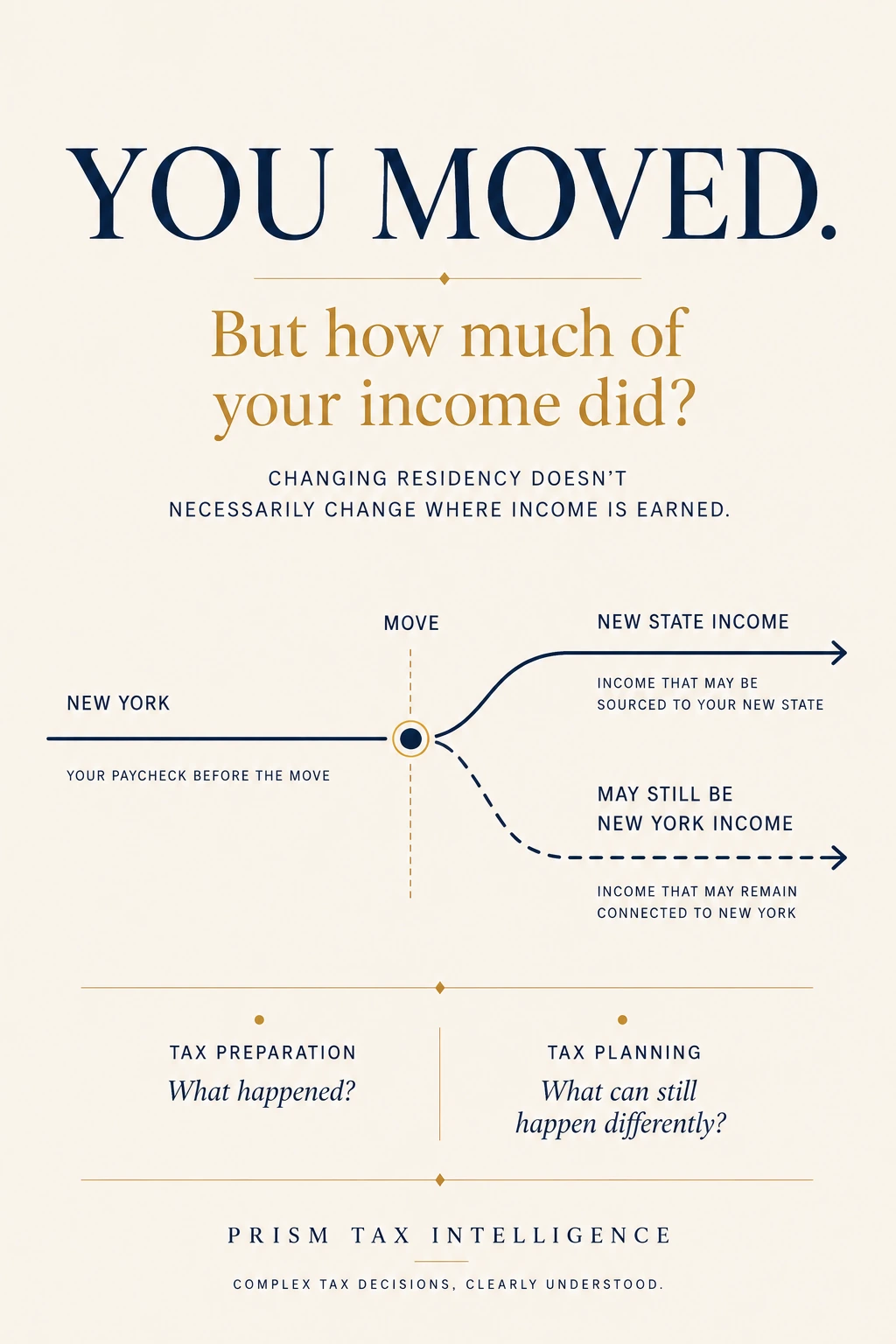
You moved.
New keys. New place. New grocery store you still haven’t figured out.
Your laptop is open on a different kitchen table. Your old address slowly disappears from the places that matter.
But Monday morning?
Same Slack notifications.
Same team.
Same meetings.
Same job.
Same paycheck landing in the same bank account.
So the assumption feels almost too obvious to question:
I work from here now. My income is here now.
Sometimes, yes.
Sometimes, not quite.
In our research at Prism Tax Intelligence, one distinction kept surfacing:
Moving the taxpayer and moving the taxpayer’s earned income are not necessarily the same tax event.
That’s where a seemingly simple move starts getting interesting.
One move can create three different tax questions.
Imagine you’re leaving New York but keeping your job.
You probably have one date in your head as moving day.
Tax law may need more than that.
Where are you a resident?
That’s the residency question.
Where did you work?
That’s part of the income-sourcing question.
What work actually produced the payment?
That can matter when compensation arrives later, such as a bonus tied to an earlier period.
The mistake is assuming all three answers changed because your address did.
They may not.
New York’s own rules distinguish residency from the sourcing of income earned by nonresidents. A person can cease being a New York resident and still have income taxable by New York because it remains connected with New York sources.
In plain English:
You can move without every part of your paycheck moving with you.
First: did you move for tax purposes?
This is where the conversation usually starts.
You signed a lease somewhere else.
Changed your address.
Maybe changed your driver’s license.
Surely that’s enough.
Not necessarily.
For New York purposes, domicile is about where you’ve established your permanent home and where you intend to return. New York’s current guidance explicitly says that simply registering to vote or filing a certificate of domicile isn’t enough; the broader facts of a person’s life matter.
There’s also a second route to residency.
Someone domiciled outside New York can generally still be treated as a New York resident if they maintain a qualifying permanent place of abode in the state for substantially all of the taxable year and spend 184 days or more in New York during that year. Any part of a day generally counts.
Which is why one of the most familiar pieces of moving advice—
“Just stay under 183 days.”
—isn’t really a residency strategy.
It’s one fact inside one test.
And even if we’ve established that you genuinely became a nonresident, we still haven’t answered the question in the title.
Now we have to follow the paycheck.
You moved. Your job came with you.
This is the situation we kept coming back to in our Prism research because it feels so ordinary now.
You leave New York.
You keep your New York job.
Instead of logging in from Brooklyn, you’re logging in from somewhere else.
Same role.
Different desk.
Where did you earn today’s wages?
The intuitive answer is:
Here. I’m sitting here.
Physical work location can matter enormously.
But states don’t all source wages the same way.
And New York has a particularly important wrinkle: its convenience-of-the-employer rule.
For a nonresident employee whose assigned or primary office is in New York, working from home outside the state does not automatically turn those days into out-of-state workdays. New York’s current instructions say that out-of-state services generally need to arise from employer necessity rather than employee convenience; its telecommuting guidance also addresses whether the employer established a bona fide employer office at the remote location.
Consider two people sitting at identical desks in the same state.
Both moved from New York.
Both work remotely.
One has an employment arrangement that actually requires the work to be performed outside New York.
The other kept a New York-assigned job and chose to work remotely after moving.
They may look identical on Zoom.
Their tax facts may not be.
That’s the part a forwarding address can’t tell you.
Remote doesn’t necessarily mean “not New York.”
This became one of the more interesting findings in our research because remote work feels like it should have made the old distinction obvious:
I’m physically working outside New York. What else is there to know?
Quite a bit, potentially.
And New York just gave us a very current example.
On July 2, 2026, the Appellate Division, Third Department upheld New York’s application of the convenience rule in Zelinsky.
The interesting part isn’t simply that the state won.
During the pandemic, the employee was required to work remotely because the New York campus was unavailable. But the court concluded that this did not establish that his employer required him to perform that work specifically from Connecticut.
He had to work remotely.
He did not, in the court’s analysis, have to work from Connecticut.
That distinction was enough to matter.
So:
“I worked from home outside New York.”
may still leave us with questions.
Where was your assigned or primary office?
Where did you physically perform the work?
Why were you working outside New York?
Did your employer require that particular out-of-state location?
Did the employment arrangement itself change when you moved?
Suddenly, What’s your new address? feels like one of the least interesting questions in the file.
Then there’s the paycheck that shows up later.
Let’s make the move July 1.
October comes around and a bonus hits your account.
You’re living in the new state.
The money arrived after the move.
So that’s new-state income, right?
Maybe.
But our Prism research kept bringing us back to a distinction that’s easy to miss:
The date money arrives isn’t necessarily the date that tells the whole tax story.
Depending on what a payment compensates, the analysis may need to consider what the payment was for, when the related services were performed, and the particular state’s allocation rules.
The bonus might arrive in one instant.
The work behind it may have happened over months.
So a better way to say it is:
When the payment arrives does not necessarily tell you where the income was earned.
Your paycheck can have a history.
That’s when “moving day” starts becoming less useful.
The deeper we went into the research, the less useful one perfect move date became as an answer to everything.
Because we kept separating the same move into different questions:
Residency: Where are you a resident for tax purposes?
Sourcing: Which state has a tax connection to the income itself?
Timing: What work or period produced the payment we’re analyzing?
And those answers don’t necessarily move together.
That leads to a surprisingly useful question:
Can you move to another state and still owe tax to the state you left?
Yes.
Changing residency does not necessarily end a state’s ability to tax income sourced to that state.
For earned income, the result can depend on where services were performed, the employer arrangement, the type and timing of compensation, and the sourcing rules of the states involved. New York, for example, expressly taxes New York-source income of nonresidents and applies specific allocation rules to wages earned partly within and partly outside the state.
That’s also why two states appearing on the same income doesn’t automatically mean the same income will ultimately bear two full layers of state tax. Resident-credit mechanisms can sometimes mitigate double taxation, although their availability and computation depend on the jurisdictions and facts involved.
The point isn’t that moving doesn’t work.
The point is that residency and sourcing need their own answers.
The rules people remember aren’t necessarily wrong.
They’re incomplete.
“Stay under 183 days.”
Potentially important. Not the whole residency analysis.
“I moved, so the old state can’t tax me.”
Residency may have changed. Income sourcing may not have.
“I work remotely now, so my wages aren’t New York income.”
Not necessarily. The employer arrangement can matter.
“My employer stopped withholding New York tax, so I’m good.”
Withholding and ultimate tax liability are different questions.
And then there’s the one that matters most to us:
“My CPA will figure it out when we file.”
They may.
But by then they’re figuring out what already happened.
Next March is a very different conversation from this May.
Imagine it’s next March.
You tell your tax professional:
“I moved last July, but I kept my New York job.”
Now the questions begin.
When did you actually move?
Where did you work?
What was your assigned office?
Why were you working remotely?
How often did you return to New York?
What compensation related to work before the move?
What records survived?
The days happened.
The work happened.
The payments happened.
The year closed.
A good tax professional can still do enormously valuable work: determine the appropriate filing position, allocate income correctly, address withholding, identify available credits, assemble evidence, and correct reporting when necessary.
But they can’t change where you worked eight months ago.
Now have the conversation in May instead.
“I’m thinking about moving in July, but I’m keeping my New York job. What should I understand before I do?”
Same person.
Same job.
Same possible move.
Completely different tax conversation.
Now the employment arrangement can be understood before assumptions are made about remote work.
Travel can be considered before the days are spent.
Compensation crossing the transition can be identified before it arrives.
Records can be preserved while they’re easy to preserve.
And the taxpayer can understand what the move changes—and what it may not—before discovering the answer on a return.
Most importantly:
Some of the variables are still variables.
This is where Prism draws a line between preparation and planning.
Tax preparation asks
What happened?
Tax planning asks
What can still happen differently?
That doesn’t mean manufacturing facts.
A move has to be real.
Work happens where it happens.
Employer requirements are what they are.
Tax positions have to follow the law and the underlying facts.
But understanding the consequences of a decision before making it is fundamentally different from reconstructing those consequences months later.
By filing season, many economically meaningful facts are already fixed.
The calendar happened.
The work happened.
The move happened.
The return reports that history. It doesn’t rewrite it.
And that may be the most important thing our research found.
Not another residency trick.
Not another magic number of days.
A timing problem.
The quality of the tax answer can depend on when you start asking the tax question.
So, how much of your income moved?
Maybe all of it.
Maybe some of your earned income remains connected to the state you left.
Maybe compensation crossing the transition needs a closer look.
The answer depends on the states involved, your residency facts, where and how you work, your employer arrangement, the compensation involved, and when the underlying work occurred.
Which is exactly why:
“I moved.”
isn’t enough.
Your new address tells us where to send the mail.
It doesn’t necessarily tell us where your paycheck belongs.
And if you’re contemplating a move while keeping the same job, the most useful time to find out probably isn’t next April.
It’s while there is still something to decide.
Sources & primary authority
- New York State Department of Taxation and Finance — tax.ny.gov (residency and domicile guidance, nonresident allocation instructions, and telecommuting guidance).
- Matter of Zelinsky v. Tax Appeals Tribunal, Appellate Division, Third Department, July 2, 2026 — New York Official Reports.
Prism Tax Intelligence research. State residency and wage-sourcing rules are highly fact- and jurisdiction-specific. This article is general educational information, not individualized tax or legal advice. Specific residency, remote-work, compensation, credit, and filing questions should be reviewed with qualified tax and legal professionals.
The tax question is only one layer of the decision.
This Prism Tax Intelligence research began with a tax question:
You moved. But how much of your income did?
But underneath it we found another:
How should a system reason about a decision while the facts—and the available choices—are still changing?
Infinis Decision explores that broader Decision Intelligence problem in “I Moved” Is Not a Tax Fact.